H. L. College of Commerce (Autonomous)
Report on
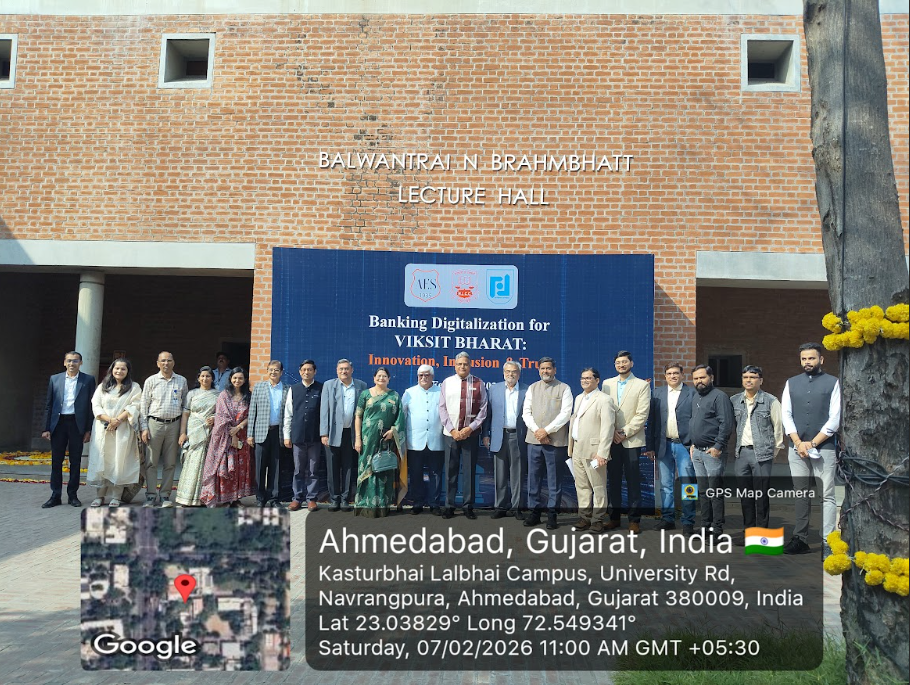
Banking Digitalization for Viksit Bharat: Innovation, Inclusion & Trust
Branch/Program/Specialization: B. Com (Hons.) Banking & Financial Services, B.S. Fintech, B.Com.(Hons.) International Finance
Name of Event: Banking Conclave
Title of Event: Banking Digitalization for Viksit Bharat: Innovation, Inclusion & Trust
Date and Time: 7th February, 2026, 10:00 A.M onwards
Venue: BNB Lecture Hall, Cept University
Name of Co-ordinators: Dr Payal Shastri, Cs Komal Kewalramani, Prof. Kaival Dave, Prof. Aman Khanna
Total No. of Participants: 400+ Students and 200+ other participants
Overview
The Banking Conclave 2026 was jointly organised by the Ahmedabad Education Society (AES), through HL College of Commerce, in collaboration with the National Institute of Bank Management (NIBM). The conclave served as a high-impact academic–industry platform that brought together senior policymakers, regulators, industry leaders, academicians, and students to deliberate on the evolving role of banking in India’s journey towards a Viksit Bharat by 2047.
Anchored around the central theme “Banking Digitalization for Viksit Bharat”, the conclave focused on the three interlinked pillars of Innovation, Inclusion, and Trust. The deliberations highlighted how emerging technologies—particularly Artificial Intelligence, digital public infrastructure, and advanced cybersecurity frameworks—are redefining banking while simultaneously emphasising the responsibility to protect and empower the common citizen.
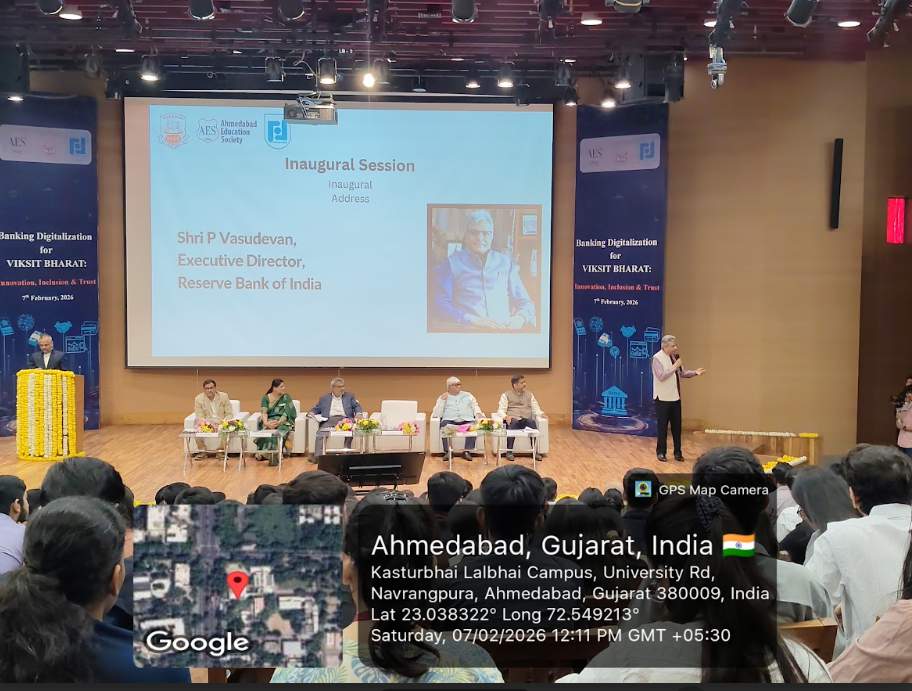
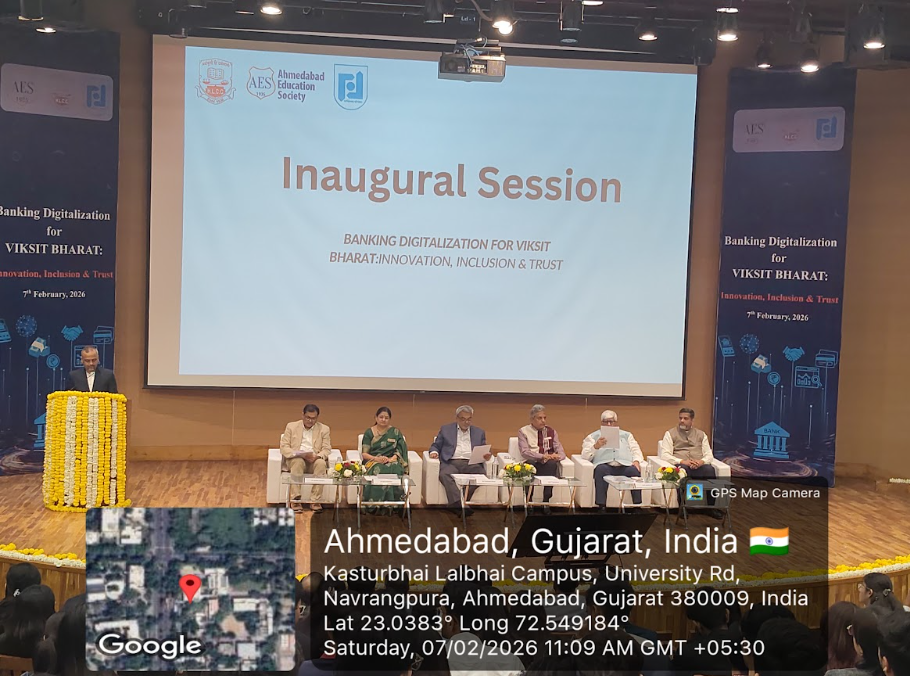
Inaugural Session
The conclave commenced with a distinguished inaugural session, setting the intellectual tone for the day. The dignitaries on the dais included:
• Shri P. Vasudevan, Executive Director, Reserve Bank of India
• Shri Naishad Parikh, Honorary Secretary, Ahmedabad Education Society
• Dr. Partha Ray, Director, National Institute of Bank Management
• Dr. Shriram Nerlekar, Director, Ahmedabad Education Society
• Dr. Mona Kelshikar, Principal, HL College of Commerce
• Dr. Naveen Kumar, Associate Professor, NIBM
Setting the Context
Dr. Parag Shah formally welcomed the dignitaries and participants, emphasising that modern banking has evolved from being a mere custodian of capital to becoming a strategic driver of India’s digital public infrastructure. He underlined the relevance of the conclave in the context of rapid digital transformation and increasing reliance on technology-driven financial systems.
Dr. Shriram Nerlekar, in his address, highlighted the transition from exclusive “brick-and-mortar” banking to inclusive, technology-enabled financial ecosystems. He aptly described the shift as one from “brick and mortar” to “click and empower”, positioning the banking sector as the central nervous system of India’s economic transformation. He outlined the two core discussion tracks of the conclave: Artificial Intelligence in Banking and Cyber Frauds: Safeguarding the Common Person.
Dr. Partha Ray articulated the conclave’s three foundational pillars:
Innovation – Leveraging AI, blockchain, and digital platforms to reimagine banking processes.
Inclusion – Integrating marginalised sections into the formal financial system, supported by initiatives such as Jan Dhan accounts and direct benefit transfers.
Trust – Strengthening regulatory frameworks and consumer protection mechanisms in an increasingly digital environment.
Inaugural Address
Shri P. Vasudevan, Executive Director, Reserve Bank of India, delivered the keynote inaugural address, contextualising India’s remarkable economic trajectory and its leadership in digital financial innovation. He highlighted that India today stands as the world’s fastest-growing major economy, driven by a powerful combination of technological adoption, financial inclusion, and policy-driven infrastructure development. He observed that India is increasingly emerging as a global model for building large-scale, inclusive digital ecosystems.
A major focus of his address was the sheer scale of India’s digital payment landscape. He noted that the country processes nearly 81 crore digital transactions every day, functioning seamlessly on a 24×7 basis. This scale, he emphasized, reflects not only technological advancement but also widespread public trust and participation in the formal financial system.
Key insights on India’s digital scale included:
Digital payments in India have evolved into a mass public utility, accessible across geographies.
Platforms such as UPI demonstrate the strength of India’s digital public infrastructure.
Continuous, real-time transactions underscore the resilience and reliability of regulatory and technological frameworks.
Shri Vasudevan also explained the concept of the Central Bank Digital Currency (CBDC) or e-rupee, describing it as a digital equivalent of physical cash issued by the RBI, but with an added feature of programmability. This allows funds to be directed toward specific purposes, ensuring targeted and efficient utilisation.
Illustrative applications of programmability include:
A student subsidy credited in e-rupees can be restricted for use only at authorised merchants.
Government transfers can be better monitored to reduce leakage and enhance delivery efficiency.
Purpose-linked payments can improve transparency in both public and private transactions.
Reassuring participants about the rapid pace of digitisation, he stressed that RBI’s foremost objective is to ensure that “your money remains safe,” reiterating that banks are, and must remain, institutions of trust. Innovation, he noted, is always pursued alongside strong safeguards to maintain systemic stability and customer confidence.
He concluded by referring to the bi-monthly Monetary Policy Statement released the previous day, which reinforces RBI’s continued focus on ease of transactions, financial safety, and customer protection. His address effectively set the tone for the conclave, highlighting the need to balance technological advancement with regulatory responsibility and trust-based governance.
Institutional Vision and Leadership Perspectives
Dr. Mona Kelshikar introduced Shri Naishad Parikh, highlighting his distinguished corporate leadership and deep commitment to education and nation-building. Shri Parikh, in his address, emphasised that technology is no longer an auxiliary support but the core operating layer of modern banking.
He spoke on:
AI-driven real-time credit scoring and predictive risk analysis
Hyper-personalised customer experiences
System-wide efficiency and resilience through intelligent platforms
His address reinforced the idea that a technologically robust banking system is integral to achieving the broader vision of a developed and inclusive India.
The inaugural session concluded with a vote of thanks by Dr. Naveen Kumar (NIBM), following which the conclave transitioned into the thematic panel discussions.
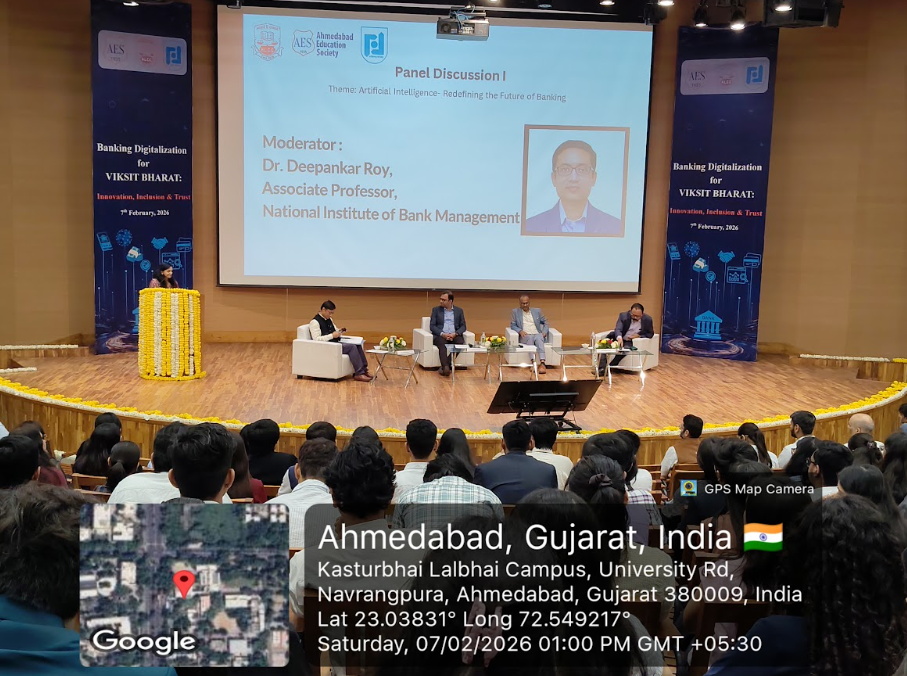
Panel Discussion 1: Artificial Intelligence: Redefining the Future of Banking:
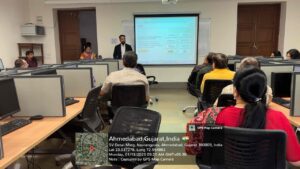
The first panel discussion was initiated by Dr. Payal Shastri, Assistant Professor, HL College of Commerce, who outlined the shift from digital banking to intelligent and adaptive financial processes and institutional adaptations. He briefed everyone about the transformational shift presently happening and built a base about the future outlook. The session was moderated by Dr. Deepankar Roy, Associate Professor, NIBM, and the Panel featured panelists which were stalwarts from the Banking and Technological ecosystem:
Shri Sandeep Ubale, CGM & Deputy Chief Digital Officer, SBI
Shri Prasanna Lohar, President, India Blockchain Forum
Shri Rahul Pandey, Fintech and Digital Transformation Leader
Key deliberations focused on:
Evolution to AI-Native Banking: Shri Sandeep Ubbale noted that while AI concepts are decades old, the recent rise of Generative AI has moved intelligence to the centre of banking. He described the transition from brick-and-mortar manual ledgers to core banking (2000s), and eventually to digital-first platforms like SBI’s YONO.
Intelligence as a Core Layer: AI is no longer just for front-line chatbots; it is now critical for identifying frauds in real-time, predicting balance sheet movements, and determining optimal locations for new branches.
Impact on Credit and Onboarding: Shri Prasanna Lohar highlighted how AI has revolutionised customer experience through video KYC and instant credit. He emphasised that AI enables “autonomous banking” by studying vast amounts of data to provide 10-second loan approvals based on real-time credit rating.
Future Vision (2035–2047): The discussion touched upon the role of AI in achieving the “Viksit Bharat” vision by 2047, focusing on financial inclusion for youth and women and driving MSME growth through automated credit risk rating.
Governance and Ethics: The panel identified the importance of “responsible AI,” focusing on explainability, bias mitigation, and adhering to regulatory expectations while scaling technology.
The Panel Discussion session 1 concluded that as banks integrate 5G, cloud, and AI-powered API ecosystems, the human side of banking—trust and responsibility—must remain at the forefront of this digital evolution. The panel concluded that while technology will continue to advance, human oversight, ethics, and trust must remain central to banking transformation.
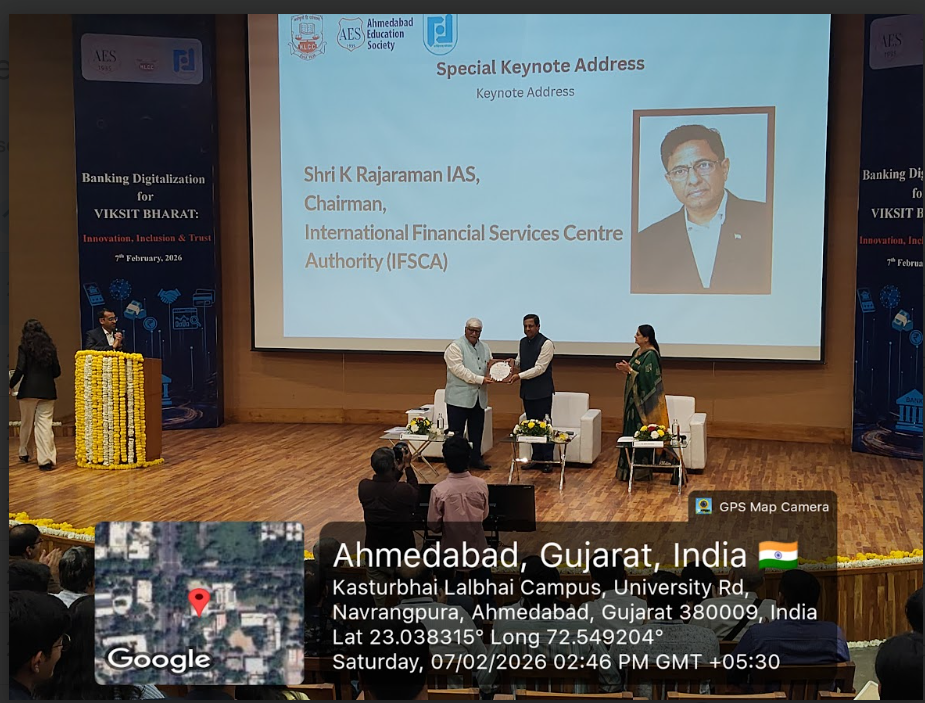
Special Keynote Address
Speaker: Shri K. Rajaraman, IAS, Chairman, International Financial Services Centre Authority (IFSCA)
Chair: Prof. Partha Ray, Director, NIBM
Shri K. Rajaraman delivered a special keynote address emphasising the critical role of technology leadership, inclusive growth, and lifelong learning in achieving the “Viksit Bharat” vision by 2047. He highlighted India’s transition from a nation with a significant unbanked population to a global leader in digital payments.
The Four Pillars of Progress
The address outlined four essential pillars for the nation’s future development:
Technology Leadership: Academic institutions must evolve from talent providers to creators of commercialised intellectual property.
Inclusive Democracy: True growth requires “flattening the pyramid,” ensuring the bottom of the socioeconomic pyramid moves into the middle class through economic and social inclusion.
Saturation of Basic Necessities: A focus on ensuring “no man or village is left behind” in access to housing, health, electricity, and telecommunications.
Decolonising the Mind: Encouraging the youth to take pride in Indian heritage and knowledge systems while remaining globally competitive.
Economic and Financial Outlook
Resilience Amid Global Uncertainty: While the global economy faces fragmentation and geopolitical tension, India maintains a strong growth path of around 7%.
Foreign Investment: Sustained trust from global investors is evident, with $50 billion in FDI recorded in the first six months of the current year.
Banking Health: The sector has seen a massive turnaround, with gross NPAs dropping from 11% in 2017 to less than 2% by September 2025.
The Digital Revolution and AI
Digital Public Infrastructure: The “Jam Trinity” (Jan Dhan, Aadhaar, Mobile) serves as the foundation for India’s digital success, with UPI now accounting for nearly 49% of global real-time retail payment volumes.
Role of AI: While AI is a “force multiplier” capable of resolving 80% of routine queries, Shri Rajaraman cautioned against “hallucinations” and emphasised that human oversight remains essential
The session concluded with a call for the youth to be the “architects and drivers” of the new India. Shri Rajaraman urged students to adopt “lifelong learning” as a mantra and to strive for world-class quality in every field, from banking to teaching.
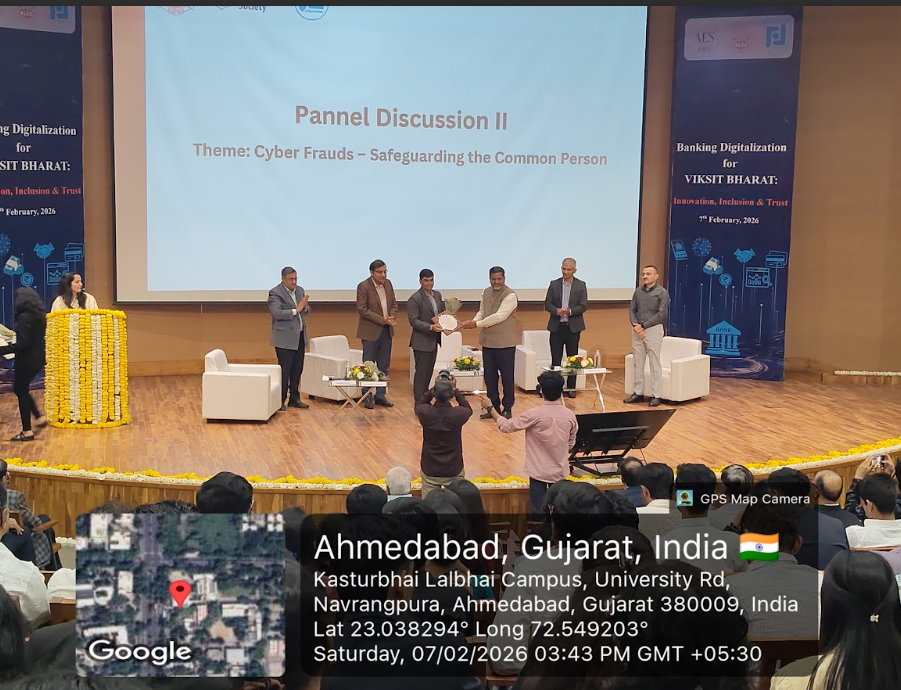
Panel Discussion 2: Cyber Frauds: Safeguarding the Common Person
The second panel discussion, led by CS Komal Kevalramani, Assistant Professor, HL College of Commerce, addressed the growing challenge of cyber frauds in a digital economy, and the session was moderated by Prof. Kaushik Mukerjee, Associate Professor at NIBM, and the Panel featured the following panellists:
Prof. Arunabha Mukhopadhyay: IIM Lucknow.
Shri Dharmendra Sharma: SP, Cyber Security, Gujarat Police.
Shri Rahil P: Chief Growth Officer, QNu Labs.
Shri Sanjay Keshwala: IPS [2021 batch], currently SP Cyber Centre of Excellence
Key Discussion Points
Human-Centric Vulnerabilities: Panellists emphasised that technology is rarely the weakest link; instead, “human psychology” is exploited. Scams often use fear (simulated police threats) or greed (fake investment tips) to bypass security measures.
The Changing Face of Fraud: The discussion covered various modern threats, including:
Investment Scams: Fraudulent trading apps promising high returns.
Extortion and Digital Arrests: Psychological manipulation to extort money through fear and social stigma.
Mule Accounts: The use of innocent individuals’ bank accounts to funnel laundered money, often involving unsuspecting students.
The Regulatory and Law Enforcement Response: Shri Dharmendra Sharma highlighted the role of the 1930 Helpline and the National Cyber Crime Reporting Portal. He stressed the importance of the “Golden Hour”—reporting a fraud within the first 1-2 hours to increase the chances of freezing the stolen funds.
Technological Safeguards: The panel discussed the future of security, including Quantum-safe cryptography and the need for banks to implement better behavioural biometrics to detect unusual transaction patterns.
The “Viksit Bharat” Connection Panellists agreed that for India to reach its 2047 economic goals, the digital ecosystem must be built on a foundation of “Trust.” UPI was cited as a prime example of an Indian innovation that now leads the world, but it requires continuous security upgrades to maintain public confidence.
The session concluded with a strong message: Cybersecurity is a shared responsibility. While law enforcement and banks work to improve infrastructure, the “common person” must remain vigilant, practice digital hygiene, and report suspicious activities immediately.
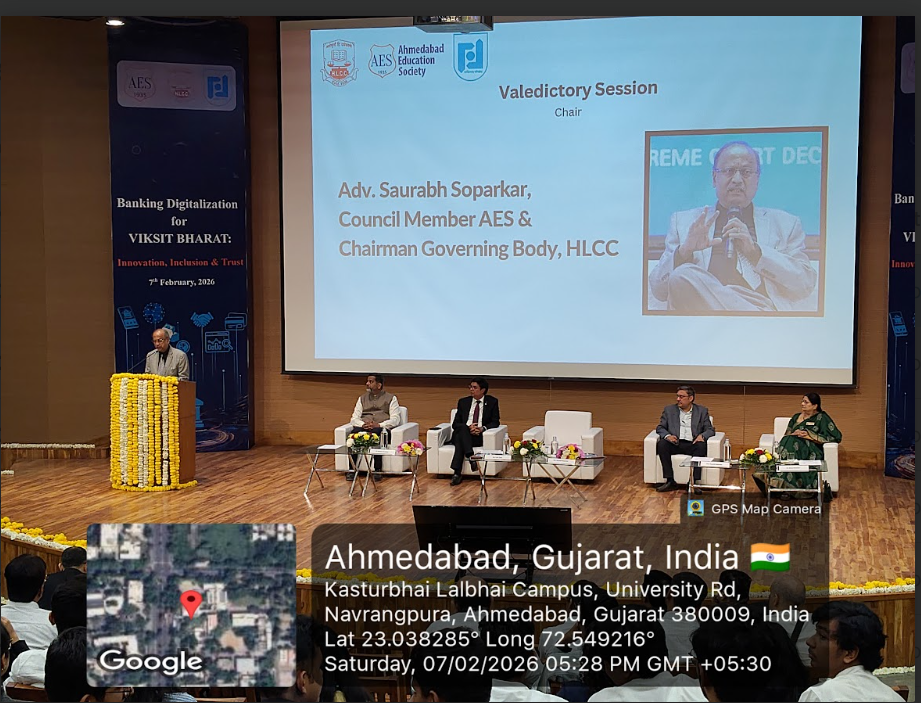
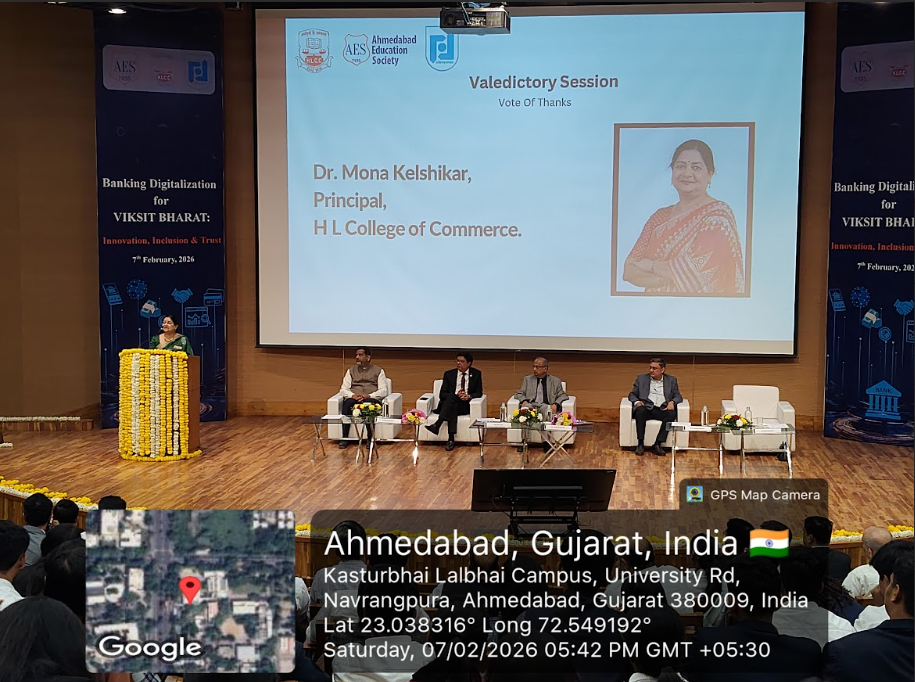
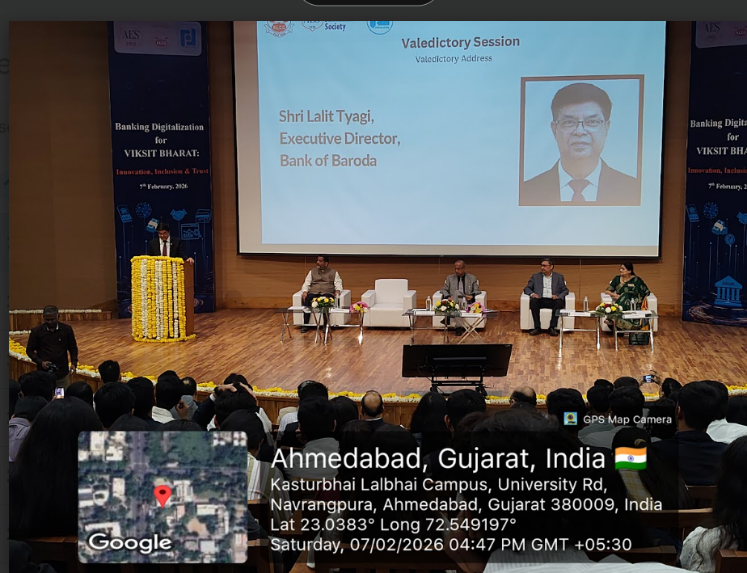
Valedictory Session
The conclave concluded with a valedictory session anchored by Prof. Aman Khanna, Associate Professor, HL College of Commerce. The session was chaired by Adv. Saurabh Soparkar, Council Member, AES and Chairman of the Governing Body, HLCC.
The valedictory address by Shri Lalit Tyagi, Executive Director, Bank of Baroda, emphasised that innovation must remain ethical, inclusive, and people-centric. He highlighted the exponential growth of digital transactions in India and outlined the journey of banking digitalisation across foundational, expansion, and acceleration phases.
He reiterated that trust, supported by strong governance and ethical frameworks, is the ultimate guardrail of innovation.
Conclusion
The Banking Conclave 2026 concluded as a powerful confluence of vision, vigilance, and responsibility. The deliberations reinforced that India’s aspiration to become a $30 trillion economy by 2047 is intrinsically linked to the digital evolution of its banking ecosystem.
The conclave left participants with three enduring takeaways:
Technology as a tool for social equity and empowerment
Trust as a shared responsibility in the digital age
A call for academia and youth to move from technology consumption to innovation leadership
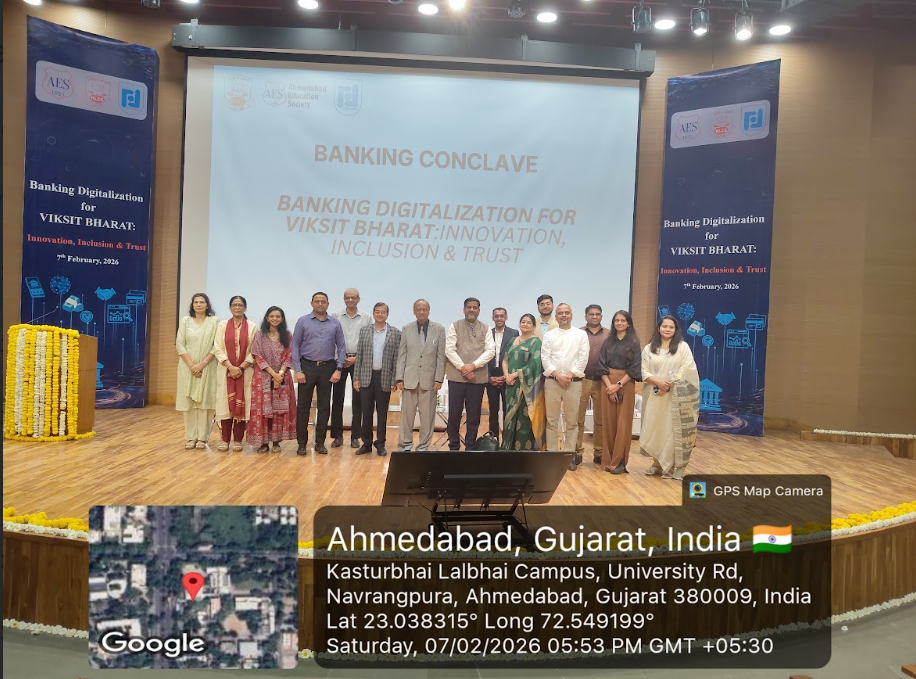
The event successfully set a benchmark for future academic–industry engagements, reaffirming the role of collaborative dialogue in shaping India’s financial future.